Over the last three posts, we laid the technical groundwork for production-grade AI. We cut through the
noise to establish practical AI
terminology, mapped out the foundational architectural
patterns for AI systems, and locked down our deployment pipelines
with CI/CD for unpredictable, real-world LLMOps.
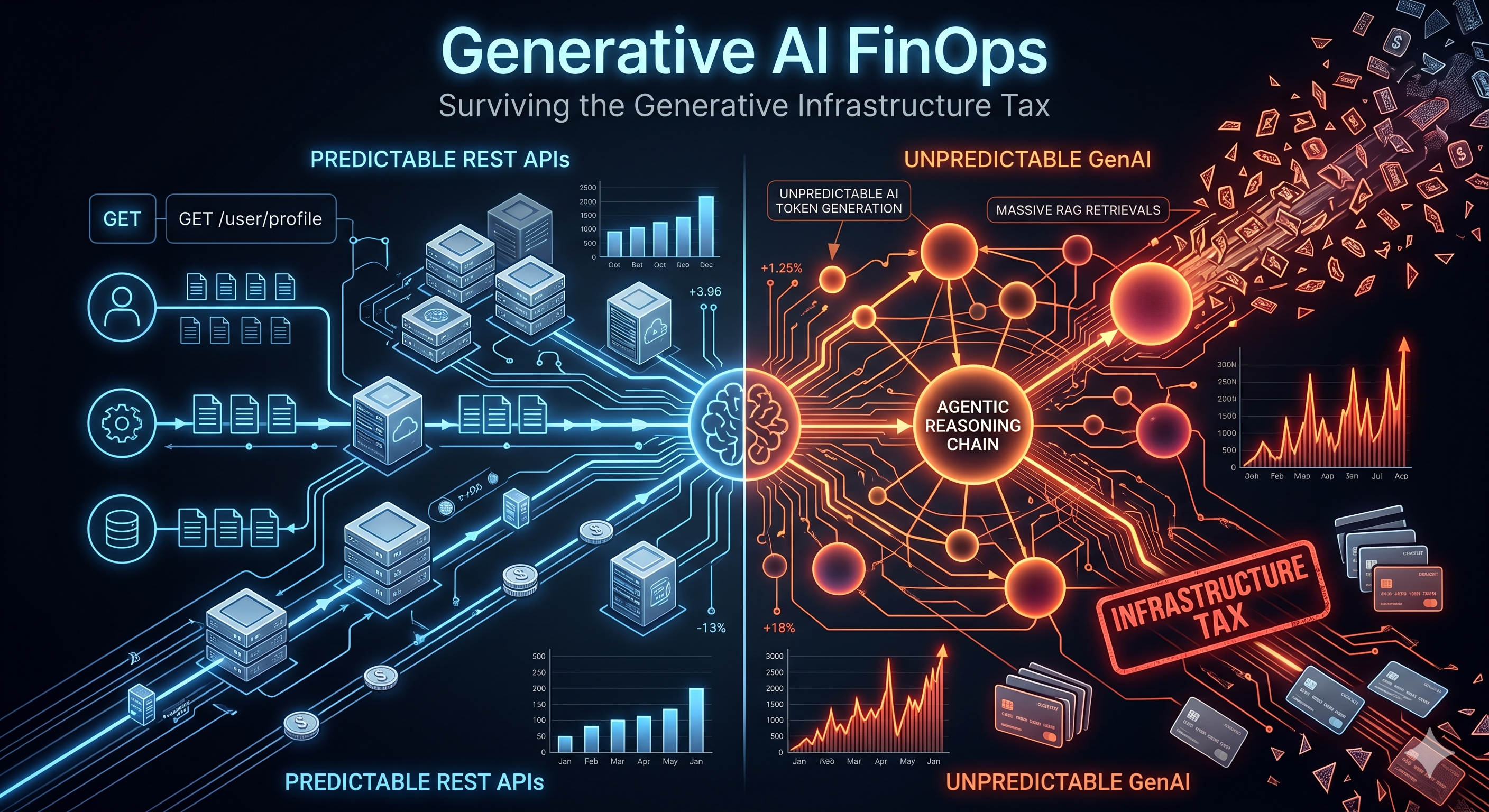
Now, the infrastructure is up, the GenAI proof-of-concept is merged, and the board is thrilled. Then the
first production cloud bill drops, and your SaaS unit economics look like a crime scene. We spent a decade
optimizing REST APIs around predictable CPU and memory footprints. Today, we are paying an unpredictable
infrastructure tax on every user interaction, where a single prompt can cost 50x more than the one before
it. You can't auto-scale your way out of this. You have to architect your way out.
The Core Problem: Variable Transaction Weight
In a standard REST API, a
GET /user/profile request consumes a highly predictable amount of
compute. You monitor the load, configure your auto-scaling groups, and watch your infrastructure costs
scale linearly with user traffic.
LLMs Shatter That Model
The fundamental problem with GenAI infrastructure is variable transaction weight. One user asks a simple
question that costs fractions of a cent. The next user submits a slightly different prompt that triggers a
chain of agentic reasoning, massive RAG retrievals, and a 4,000-token generation. You are no longer paying
a flat cloud hosting fee. You are paying a toll on every word.
Three Architectural Patterns for AI Cost Control
1. Semantic Caching: Stop Paying for the Same Answer
In traditional web architecture, we throw Redis or Memcached in front of our databases to intercept
repetitive queries. We need to apply the exact same principle to LLMs. Standard key-value matching fails
here because human language is infinitely variable.
How do I reset my password?and
I forgot my login info, helpare string-inequivalent but semantically identical.
The Pattern: Introduce a semantic cache layer between your application and the LLM.
When a
prompt arrives, convert it into a cheap, fast vector embedding, query for highly similar past prompts,
and
return a cached response if the similarity threshold is high enough (for example, 0.95). If it misses,
route to the LLM and cache the new prompt-response pair.
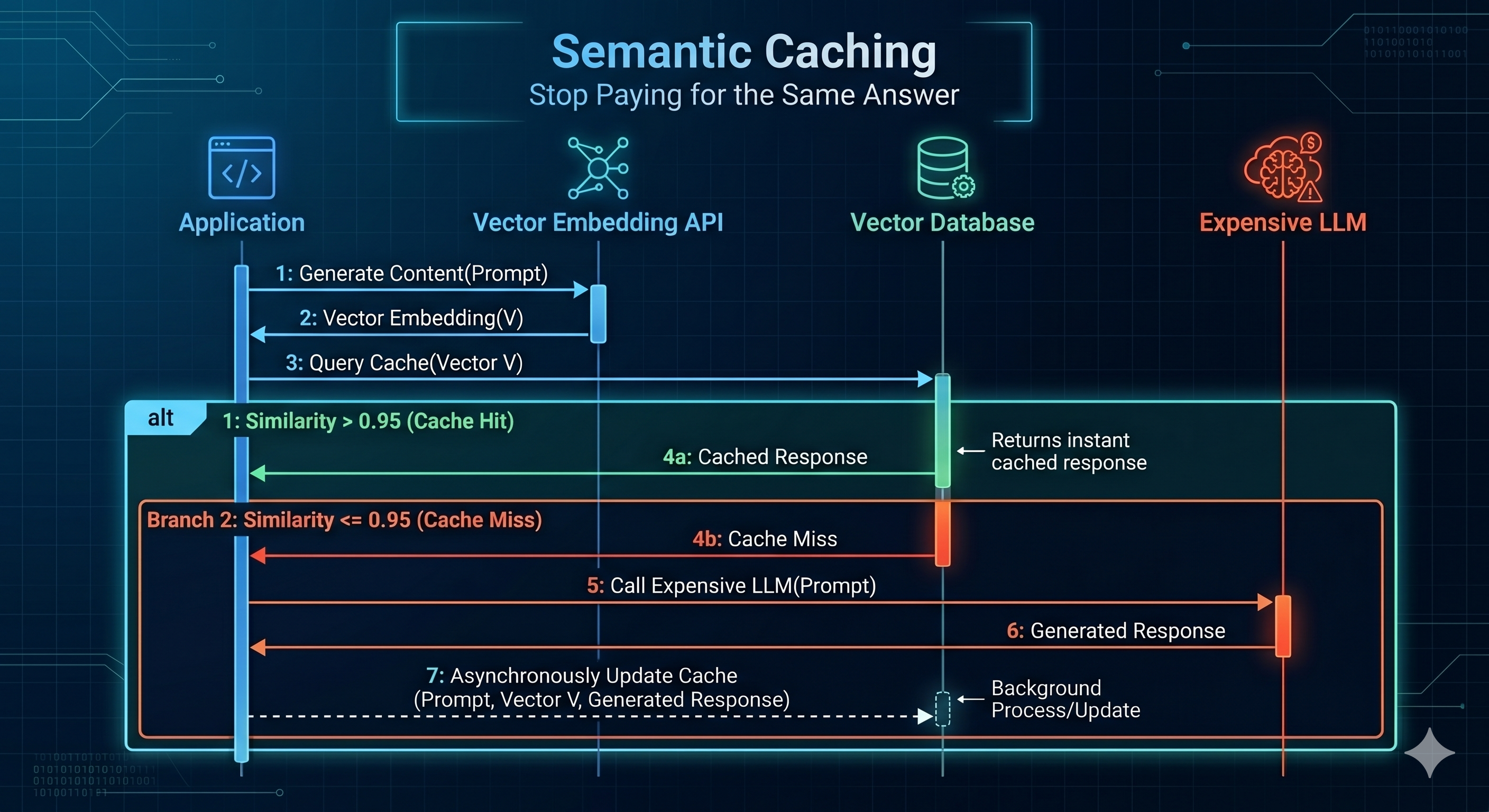
The Trade-off: You trade API costs for latency and storage. If your hit rate is low,
you
add vector lookup overhead and database costs without meaningful savings.
2. Intelligent Model Routing: The Gateway Pattern
The most expensive mistake engineering teams make is routing all traffic to a frontier model by default.
Sending basic text extraction to GPT-4 or Claude 3.5 Sonnet is the equivalent of spinning up a
supercomputer to run a basic SQL JOIN.
The Pattern: Implement an LLM gateway that routes requests by intent, complexity, and
user
tier. Trivial tasks route to cheaper, faster models, while deep reasoning tasks route to frontier
models.
You can also enforce service-tier controls so premium users get premium inference paths.
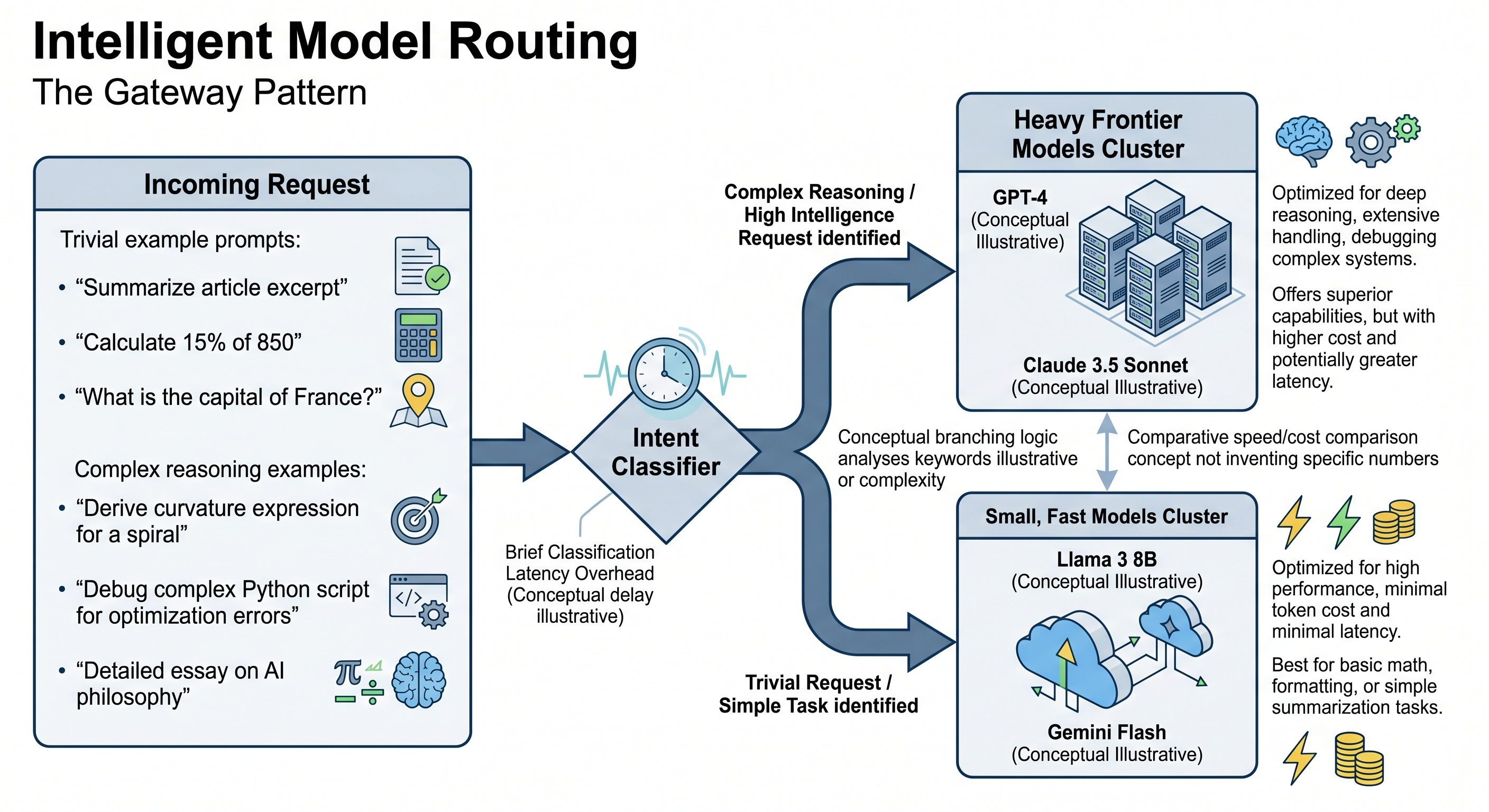
The Trade-off: You inherit real architectural complexity: multiple provider schemas,
context-window mismatches, fallback orchestration, and classification latency.
3. Token Budgeting: Moving Beyond RPM
Traditional gateways rate-limit by Requests Per Minute (RPM). In an AI system, RPM is a vanity metric.
Ten
cheap prompts cost almost nothing; ten high-context prompts can wreck your margins.
The Pattern: Enforce stateful Token-Per-Minute (TPM) budgets tied to identity.
Intercept
each model response, calculate input and output tokens, deduct from a rolling budget, then degrade
gracefully when a user hits limits by throttling, downgrading model class, or triggering upsell
workflows.
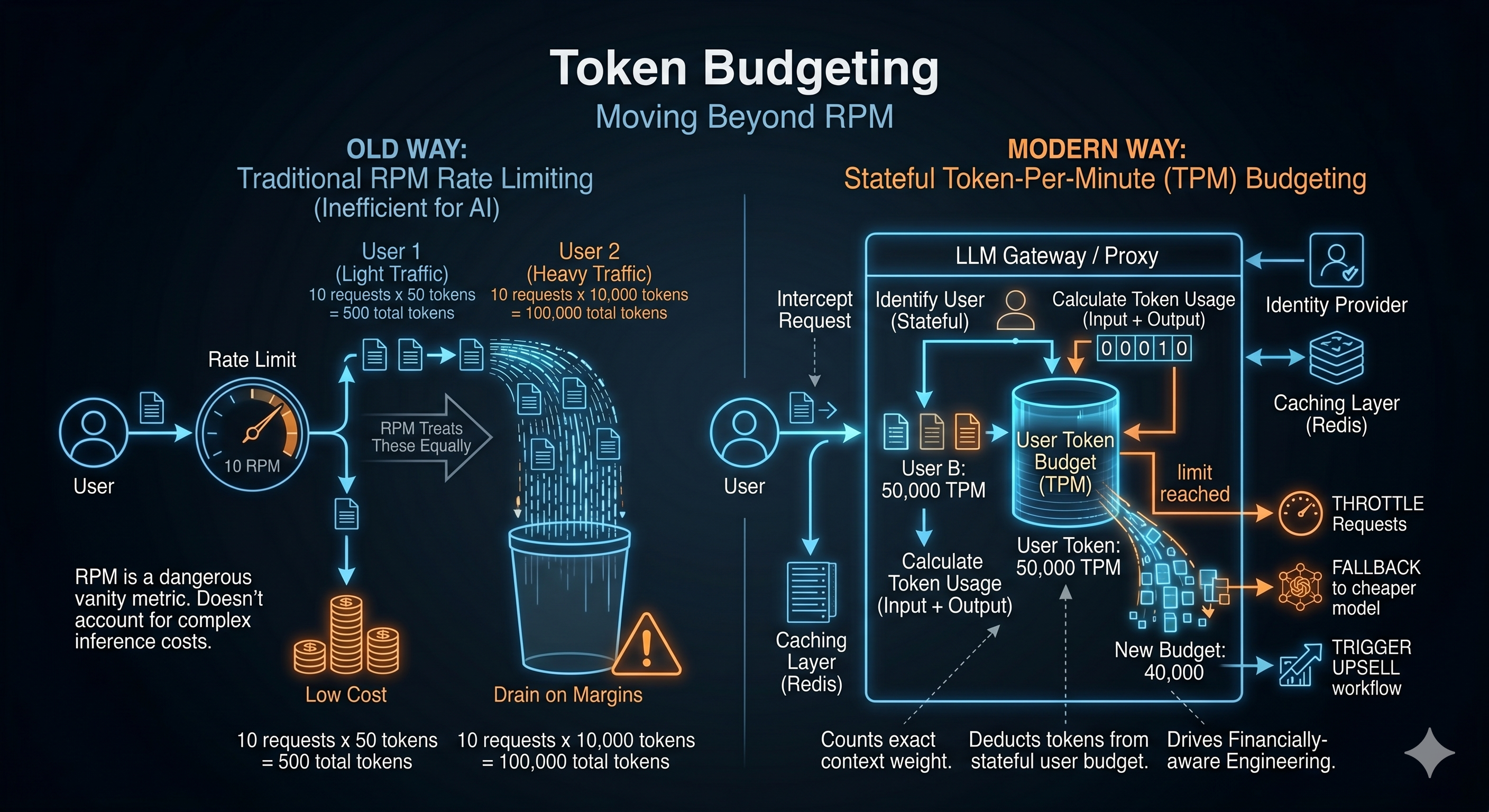
The Trade-off: This forces state and billing awareness into your gateway layer, which
increases coupling with cache, identity, and monetization systems.
The Pragmatic Reality: Cost is a System Constraint
AI FinOps is not about hunting for the cheapest cloud provider. It is recognizing that in generative AI,
cost is a first-class architectural constraint. We can no longer treat LLMs as magical black boxes where we
send strings and hope the monthly bill stays reasonable. We have to wrap them in financially-aware,
production-grade engineering controls.
Final Thought
Never expose an un-cached, un-routed frontier LLM directly to the public internet. If your system design
does not explicitly account for token efficiency and intent-based routing, you have not finished designing
it.
In Generative AI, bad architecture doesn't just cause downtime—it drains budgets. Ultimately, Your
architecture diagram is your financial forecast.
What architectural trade-offs are you making to keep your LLM costs under control? Drop your strategies in
the comments, or send this to the engineering leader staring down their first production AI bill.
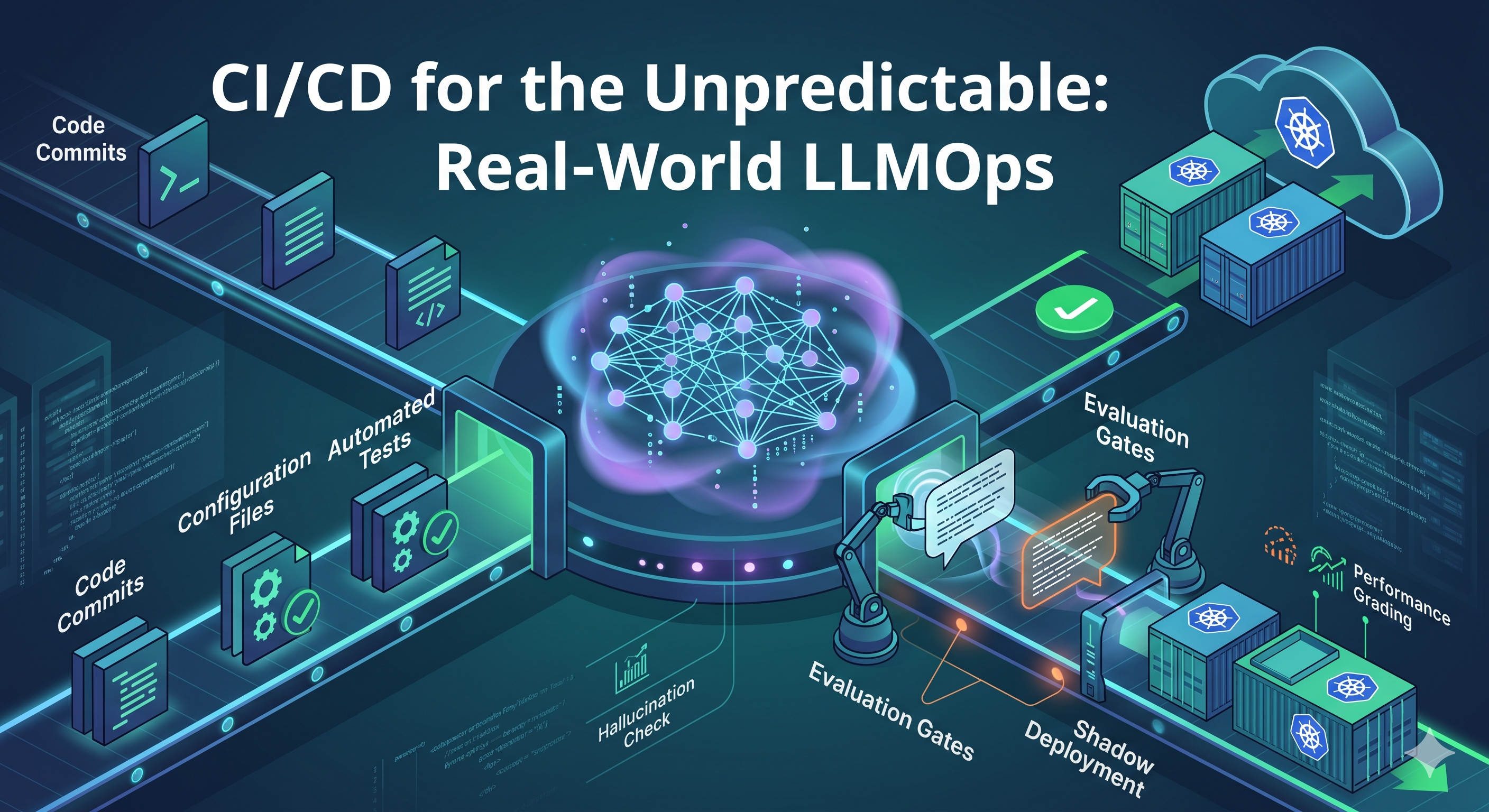 CI/CD for the Unpredictable: Real-World LLMOps
Post a Comment
Post a Comment